
In the last decade and a half the concept of worker precariousness has gained renewed currency among social scientists.1 This trend grew more pronounced after the Great Financial Crisis of 2007–2009, which left in its wake a period of deep economic stagnation that still persists in large parts of the global economy.2 Most scholars define precariousness by reference to what workers lack, including such factors as: ready access to paid employment, protection from arbitrary firing, possibility for advancement, long-term job stability, adequate safety, development of new skills, living wages, and union representation.3
The origin of the concept of worker “precariousness” is often traced to Pierre Bourdieu’s early work on Algeria.4 Yet researchers routinely pass over Bourdieu’s own mature reflections on the concept, in which he connected the notion directly to Karl Marx’s analysis of the reserve army of labor. “Precariousness,” for Bourdieu, is present when “the existence of a large reserve army…helps to give all those in work the sense that they are in no way irreplaceable.” In line with Marx’s conceptions of the floating, latent, stagnant, and pauperized populations constituting the industrial reserve army, Bourdieu associated precariousness particularly with what he called the “subproletariat.” He tended, however, to see a disjuncture between such “subproletarians” and the “proletariat,” with the latter defined by the stability necessary to initiate a “revolutionary project.”5
As a concept, worker precariousness is far from new. It has a long history in socialist thought, where it was associated from the start with the concept of the reserve army of labor. Frederick Engels introduced the idea of precariousness in his treatment of the industrial reserve army in The Condition of the Working Class in England.6 Marx and Engels employed it in this same context in The Communist Manifesto, and it later became a key element in Marx’s analysis of the industrial reserve army in volume I of Capital. Early Marxian theorists, notably William Morris, extended this analysis, explicitly rooting much of their critique of capital in the concept of “precariousness.” The notion of precariousness was thus integrally related to the Marxian critique of capitalism. It was to gain added significance in the 1970s, in the work of theorists such as Harry Braverman and Stephen Hymer, who explored the relation of surplus labor to the conditions of monopoly capitalism and the internationalization of capital.
For many years, Marx’s analysis of the “general law of capitalist accumulation,” which had pointed to conditions of growing precariousness with respect to employment and to the relative impoverishment of the laboring population, was dismissed by mainstream social scientists as constituting a crude theory of immiseration.7 In recent years, however, the notion of precariousness as a general condition of working-class life has been rediscovered. Yet the idea is commonly treated in the eclectic, reductionist, ahistorical fashion characteristic of today’s social sciences and humanities, disconnected from the larger theory of accumulation derived from Marx and the socialist tradition. The result is a set of scattered observations about what are seen as largely haphazard developments.
Some critical social scientists, most notably former International Labour Organization (ILO) economist Guy Standing, employ the neologism “precariat” to refer to a new class of mostly younger workers who experience all of the main aspects of precariousness. As French sociologist Béatrice Appay explains, the term precariat “emanates from a contraction of the words ‘precarious’ and ‘proletariat.’ It regroups the unemployed and the precarious (manual and intellectual) workers in struggle in all sectors of activity.”8 But since Marx himself defined the proletariat as a class characterized by precariousness, the term precariat is often no more than a fashionable and mistaken substitute for proletariat itself (in Marx’s sense)—or else is employed to refer to a subcategory of the proletariat, i.e., the subproletariat. This resembles earlier theorizations of the “underclass” as a separate entity divorced from the working class as a whole.9 In these various formulations, the notion of the precariat is often contrasted with what is characterized as an overly rigid concept of the proletariat—the latter defined as a formal, stable industrial workforce of the employed, usually organized in trade unions (a notion, however, far removed from Marx’s classical definition of the proletariat).
Radical French sociologist Loïc Wacquant suggests that “contrary to the proletariat in the Marxist vision of history, which is called upon to abolish itself in the long run by uniting and universalizing itself, the precariat can only make itself to immediately unmake itself”—meaning that its only choices are to join the formal workforce and obtain “stable wages” or to escape “from the world of work altogether.” For Wacquant, the growth of working-class precariousness is a movement toward “deproletarianization rather than toward proletarian unification.” The fact that Marx himself presented the conditions of the working class primarily in terms of the precariousness of employment and existence—a fact we will elucidate below—is here missed altogether. Instead the concepts of the precariat and of worker precariousness are being advanced as alternatives to the proletariat, often in order to suggest the impossibility of a worker-based revolutionary project in contemporary conditions, in the tradition of André Gorz’s proclamation of Farewell to the Working Class.10
According to socialist critic Richard Seymour, in his essay “We Are All Precarious,” “the ‘precariat’ is not a class, and its widespread acceptance as a cultural meme in dissident, leftist culture has nothing to do with the claim that it is. Rather, it is a particular kind of populist interpellation” (identification), one that “operates on a real, critical antagonism in today’s capitalism”: the growth on a world scale of an increasingly flexible work force, characterized by unemployment, underemployment, and temporary, contingent employment.11
In contrast to such varied discursive views, emanating primarily from sections of the left influenced by postmodernism, establishment sociologists typically conceptualize worker precariousness in more prosaic terms, as nothing more than a widening gulf between “good jobs” and “bad jobs.” Moreover, there is a strong tendency to adopt a corporatist view in which the goal of all classes is to reestablish a “social contract between organized labor and organized capital.”12 The object, in other words, is to regulate working conditions in order to shift back from informal to formal labor. This project is naturally seen as a response to the decline of organized labor.13 But such superficial, reformist analyses rarely explore the historical dynamics of capital accumulation that have driven the resurgence of precariousness at the center of the capitalist world economy. In general, conventional social scientists lack the analytical tools to address a phenomenon rooted in the intrinsic character of capital accumulation. Century-old conceptual blinders block their vision.
In the face of such a confusion of views—most of them merely ad hoc responses to what is presumed to be an isolated social problem—it is necessary to turn back to the classical Marxian tradition, where the issue of precariousness was first raised. Here the ideas of Marx, Engels, and Morris in the nineteenth century, and those of thinkers such as Harry Braverman, Stephen Hymer, and Samir Amin in more recent times are indispensable. Applying the analytical frameworks provided by these thinkers, it is possible to look at the empirical dimensions of worker precariousness, both in the United States and globally, and to arrive at definite conclusions about the evolution of capital accumulation and working-class precariousness in our age, as well as its effect on the current epochal crisis.
Engels, Marx, Morris, and the Concept of Precarious Labor
The theoretical construct of worker precariousness tied to the industrial reserve army of labor had its origin, as indicated above, in classical historical materialism, particularly in the work of Engels, Marx, and Morris. In The Condition of the Working Class in England, Engels wrote:
Every new advance brings with it loss of employment, want, and suffering, and in a country like England, where, without that, there is usually a ‘surplus population,’ to be discharged from work is the worst that can befall the operative. And what a dispiriting, unnerving influence this uncertainty of his position in life, consequent upon the unceasing progress of machinery, must exercise upon the worker, whose lot is precarious enough without it!14
The working class’s general condition thus can be described in terms of precariousness, where the constant threat of being thrown into the “surplus population” of the unemployed and underemployed only intensifies over the course of capital accumulation. For Engels, this was an integral part of the theory of an “unemployed reserve army of labor” that constituted the whole basis for bourgeois exploitation of the proletariat. In The Communist Manifesto, Marx and Engels followed this same line of thought, stating, “The growing competition among the bourgeois, and the resulting commercial crises, make the wages of the workers ever more fluctuating. The unceasing improvement of machinery, ever more rapidly developing, makes their livelihood more and more precarious.”15
It was in Capital, however, that Marx was to develop fully the concept of the reserve army of labor, and with it a theory of the precariousness of working-class employment and working-class life itself. In explaining the general law of accumulation, he wrote,
The law by which a constantly increasing quantity of means of production may be set in motion by a progressively diminishing expenditure of human power, thanks to the advance in the productivity of social labor, undergoes a complete inversion, and is expressed thus: the higher the productivity of labor, the greater is the pressure of the workers on the means of employment, the more precarious therefore becomes the condition for their existence, namely the sale of their own labor-power for the increase of alien wealth.16
A few pages earlier he stated, similarly, “the more alien wealth they [the workers] produce, and…the more the productivity of their labour increases, the more does their very function as a means for the valorization of capital become precarious.”17
Marx, in developing this analysis, discussed the “different forms of the existence of the relative surplus population,” as concrete manifestations of the “general law of accumulation.” Here he singled out four distinct forms: the floating, latent, stagnant, and pauperized populations. The most tumultuous layer of the reserve army was thefloating population, which comes into existence as a counterpart to the extensive application of machinery and the resulting intensification of the labor process. Here, at the center of modern industry, the working population is in constant flux—not only because of an unceasing compulsion of capital to reduce its labor requirements, but also because the “consumption of labor-power is so rapid” that the human body can only withstand the physical torture of work for a short time before it is no longer suitable to capital.
The factories, workshops, and mines, thus tend to seek out the freshest, most easily exploitable layers of the reserve army—particularly children, young women and “nomadic” (migrant) laborers. Because of the chaotic and intense nature of production in modern industry, flows in and out of the floating population tend be extremely high. Workers are “repelled and attracted, slung backwards and forwards, while, at the same time, constant changes take place in the sex, age, and skill of the industrial conscripts.”
For Marx, this manic relation to labor is a distinguishing feature of modern industry: the attraction of new labor at one moment, during an economic expansion, is matched by an equally strong repulsion in the next historical moment, during an economic contraction. Nevertheless, the floating population consisted of workers who had a definite connection—if a somewhat precarious one—to the active labor army, with a recent history of employment. These workers would likely be the first to be re-hired in an expansion.18
The next layer of the reserve army, in Marx’s description, is the latent surplus population. For the most part this refers to the (relatively self-sustaining) segments of the agricultural (or rural) population. This population served as a vast source of potential labor for capitalist industry (hence, “latent”). Internationally, Ireland, as Marx pointed out, constituted a vast labor reserve, with a huge latent population of largely overpopulated rural workers at the beck and call of English industry. Such conditions were the result of the English conquest of Ireland and subsequent colonial history. “Ireland,” he explained, “is at present merely an agricultural district of England which happens to be separated by a wide stretch of water from the country for which it provides corn, wool, cattle and industrial and military recruits.” So precarious were the conditions of rural laborers in England and Ireland that they “had one foot already in the swamp of pauperism,” making it easy to attract them to industry when needed, and unceremoniously discard them the moment they were no longer of direct use to capital accumulation.19
The stagnant population was for Marx the sharpest representation of the precariousness that characterized the labor force as a whole. This layer continuously absorbed the stream of workers expelled from modern industry and agriculture, representing an “inexhaustible reservoir of disposable labor-power.” It was “characterized by a maximum of working time and a minimum of wages.” Here employment was “extremely irregular”; and to the extent its members attained employment at all, their degree of exploitation tended to be extremely high. This was the “self-reproducing and self-perpetuating element of the working class,” which was forced back further upon its own devices.
The stagnant population represented “a proportionately greater part in the general increase” of the working class, with its growth in “inverse proportion to the level of wages.” Such was the condition of workers in the stagnant population, Marx wrote, that “it calls to mind the boundless reproduction of animals individually weak and constantly hunted down.” It is here that Marx famously anticipated the notion of the demographic transition, arguing that population increase, contrary to Malthusian assumptions, falls rather than rises with an increase in wages. In relation to the stagnant population, he pointed out that day labor, particularly in Ireland, constituted the “most precarious form of wage” labor of all, since it often required traveling long distances to get to work and back, long hours for abysmal pay, and absolutely no safeguards, promoting disease and poverty.20
Central to the structural conditions governing the stagnant population was the development of “so-called domestic industry” or “modern domestic industry,” alongside “modern manufacturing” (modern handicraft production).21 Modern domestic industry mainly took place in the homes of workers or in small workshops, for example lace-making establishments. This was a form of what Marx called “outwork” or subcontracting attached to the factory system. In modern domestic industry, he wrote, exploitation is “still more shameless than in modern manufacture,”
because the workers’ power of resistance declines with their dispersal; because a whole series of plundering parasites insinuate themselves between the actual employer and the worker he employs; because a domestic industry has always to compete either with the factory system, or with manufacturing in the same branch of production; because poverty robs the worker of the conditions most essential to his labor, of space, light and ventilation; because employment becomes more and more irregular; and, finally, because in these last places of refuge for the masses made ‘redundant’ by large-scale industry and agriculture, competition for work necessarily attains its maximum.22
Labor conditions were particularly horrid in modern domestic industry because it took the stagnant surplus population as its basis. Here was to be found a super-abundance of cheap, freshly exploitable labor—most of them women and children. The precariousness of workers in modern domestic industry was reflected in the fact that workers were rendered “redundant in the form of under-payment and over-work” to the point of superexploitation. The typical modern domestic industry was preponderantly women and young girls, working in garment establishments as “outworkers” attached to modern manufacture. They were “always paid less than the minimum wage.”23
Marx pointed to a shirt factory in Londonderry that employed one thousand workers in the factory and a further “9,000 outworkers spread over the country districts.” Such outworkers were employed in small sweatshops dispersed over wide areas, weakening their power to organize collectively and resist. This tended to accentuate the “murderous side of this economy,” most notoriously the “mistress’s houses” in clothing manufacture. “In English barracks the regulation space allotted to each soldier is 500 to 600 cubic feet, and in the military hospitals 1,200 cubic feet. But in those finishing sties there are between 67 and 100 cubic feet for each person. At the same time the oxygen of the air is consumed by gas lamps.” Children beginning work at age six and working fourteen-hour days (or more), “when business is brisk,” were not uncommon.24
What Marx called “modern industry” or the factory system increasingly came under the Factory Acts, while branches of production associated with modern domestic industry (and modern manufacture), which the stagnant population depended on for its exceedingly precarious employment, were still “without legal limit to exploitation,” unfettered by “legal regulations.” It thus corresponded in today’s parlance with the informal economy. Here, Marx insisted, could still be found conditions where children were required to work from 4:00 A.M. to midnight. He quoted the Daily Telegraph to the effect that in these sectors there was still a struggle to limit the workday to eighteen hours! Examining branches of production as varied as pottery, wallpaper making, bread making, and lacemaking, Marx ended with a discussion of the conditions of dressmakers in London, which was to overlap with his later discussion of modern domestic industry. He recounted the story, notorious at the time, of twenty-year-old Mary Anne Walkley, who had died after working continuously for more than twenty-six hours, in one of the most respectable dressmaking establishments in London, under conditions of a chronic lack of sleep, oxygen, and space. Walkley was being forced to work long hours to produce dresses for a ball announced by the Princess of Wales. Even the Morning Star, the organ of free traders, responded by declaring “our white slaves, who are toiled into the grave, for the most part silently pine and die.”25
As Joseph Fracchia notes, the exploitation of labor power under capitalism, with the reserve army as its fulcrum, “is not abstract but concretely rooted in individual bodies, it is [for Marx], ‘that monstrosity of a suffering population of workers held in reserve for the changing exploitative needs of capital.’… Capitalism reproduces its supply of labor-power by perpetuating, over generations, a class of ‘needy individuals.’ And life-long neediness is a concerted attack on the body and the bodily capacities of those in need.”26 The precariousness of employment under capitalism extends to the conditions of work itself, and to the using up of the corporeal basis of human existence.27
The stagnant population, for Marx, shaded into the fully pauperized population—the “lowest sediment” of the relative surplus population. The pauperized layer, which included both the lowest segments of the relative surplus population and elements that were past all employment, held down the industrial reserve army and the working class as a whole. The largest portion of this layer dwelled “in the sphere of [official] pauperism”—the remainder consisting of “vagabonds, criminals, prostitutes, in short the actual lumpenproletariat.” The degrees of “official pauperism” Marx identified included:
First, those able to work. One need only glance superficially at the statistics of English pauperism to find that the quantity of paupers increases with every crisis of trade, and diminishes with every revival. Second, orphans and pauper children. These are candidates for the industrial reserve army, and in times of great prosperity, such as they year 1860, for instance, they are enrolled in the army of active workers both speedily and in large numbers. Third, the demoralized, the ragged, and those unable to work, chiefly people who succumb to their incapacity for adaptation, an incapacity which results from the division of labour; people who have lived beyond the worker’s average life-span; and the victims of industry, whose numbers increase with the growth of dangerous machinery, of mines, chemical works, etc., the mutilated, the sickly, the widows, etc. Pauperism is the hospital of the active labour-army and the dead weight of the industrial reserve army. Its production is included in that of the relative surplus population, its necessity is implied by their necessity; along with the surplus population, pauperism forms a condition of capitalist production, and the capitalist development of wealth.28
In The Condition of the Working Class in England, Engels emphasized that the poorest parts of the working class were forced to hawk whatever they could, “huckstering and peddling” on every street corner, eking out a precarious existence by selling “shoe and corset laces, braces, twine, cakes, oranges, every kind of small articles,” as well as “matches…sealing wax, and patent mixtures for lighting fires.” Other “so-called jobbers” went about the streets looking for any kind of small job: a few hours or a day of work. Such was the kind of informal economy that has everywhere been associated with poverty.29
Marx drew on census statistics for England and Wales to point to the much higher formal employment of working-class women than men, largely because women made up 85 percent of all domestic servants. The numbers of domestic servants exceeded those of both textile factory workers (the vast majority of which were women and young children) and metal workers (where there were fewer workers than in textiles, but who were predominantly men). Precariousness, in the sense of being part of the reserve army, was thus even more likely to fall on men, who traditionally earned higher wages than women when employed, but were increasingly deemed unemployable by a capitalist industry forever looking for cheaper labor—and by the well-to-do looking for largely female domestic servants.
Capitalism was not confined to single countries but was a global system of production. Exploitation, in Marx’s view, was thus increasingly an international phenomenon, one that encompassed the wider periphery through colonialism. “A new and international division of labor springs up, one suited to the requirements of the main industrial countries, and it converts one part of the globe into a chiefly agricultural field of production for supplying the other part, which remains a preeminently industrial field.”30 He pointed out that “the profit rate is generally higher [in the periphery] on account of the lower degree of development, and so too is the exploitation of labor through the use of slaves, coolies, etc.” If life was cheap and expendable in the center of the capitalist system it was even more so in the colonized periphery, where conditions of primitive (primary) accumulation continued to prevail. In Marx’s account of “the genesis of the industrial capitalist,”
the extirpation, enslavement and entombment in mines of the indigenous population…the beginnings of the conquest and plunder of India, and the conversion of Africa into a preserve for the commercial hunting of blackskins, are all things which characterize the dawn of the era of capitalist production. These idyllic proceedings are the chief moments of primitive accumulation.31
Marx’s theory of working-class precariousness was to be extended by the most brilliant Marxian theorist of late nineteenth-century England, the celebrated artist, writer, and socialist William Morris. It was Morris more than any other thinker in the 1880s and ’90s who built on Marx’s theory of the reserve army of labor, as manifested primarily in the growing precariousness of workers. As he declared in 1883, in his essay “Art Under Plutocracy,” the degradation of the labor process under capitalism, and the narrow cash-nexus terms on which employment was provided or denied, resulted in conditions for the worker that were extremely “precarious.” Likewise, in his famous lecture “Useful Work versus Useless Toil,” first delivered in 1883 and later incorporated into his 1888 book Signs of Change, Morris wrote of “the precariousness of life among the workers” resulting from the tendency “to increase the number of the ‘reserve army of labor.'” The monetary contributions that workers made to trade unions were an extra charge that workers had to pay out of their wages simply to combat “precariousness of…employment,” against which organized labor was the only defense.32
So important did Morris consider this issue in defining the condition of workers under capitalism that in his 1887 lecture “What Socialists Want,” he took the unusual step—rare in his lectures—of penciling “precariousness” in the margin, indicating that it was a major theme to develop further. Later, in his 1894 lecture “What Is: What Should Be: What Will Be,” Morris argued that “higher wages and less precarious work, more leisure, more share in public advantages” constituted the main demands of the workers, but that these goals could only be achieved via “the beginnings of Socialism.” For Morris, it was the instability of working class life—the constant struggle to hold on to or find a job, the threat (and reality for many) of unemployment and underemployment, the extreme moral and physical suffering, degradation, and even death brought on by exploitative working conditions, and the omnipresence of pauperism—that constituted the essence of working-class life. Such insecurity, degradation, and useless toil undermined all free human potential.33
The Global Reserve Army in the Age of Generalized Precariousness
The structural basis of Marx’s concept of worker precariousness was the reserve army of labor, the fulcrum of the general law of capitalist accumulation. Against today’s use of “precariousness” or “precarity” as what Seymour calls a “cultural meme,” Marxian theory instead offers an integrated theoretical approach and scientific outlook to working class insecurity and exploitation, geared to revolutionary social change. Here the notion of the proletariat is not seen as opposed to precariousness—giving rise to a whole new category of the “precariat”; rather, precariousness is a defining element in working-class existence and struggle.
In the immediate post-Second World War years, the capitalist world economy, centered in the United States, Western Europe, and Japan, experienced a period of rapid economic expansion based on: (1) undisputed U.S. hegemony; (2) a second wave of automobilization in the United States; (3) the rebuilding of the war-torn economies in Europe and Japan (and automobilization there); (4) the massive growth of the sales effort based in Madison Avenue; and (5) two regional wars in Asia, along with the general militarization trend associated with the Cold War. Higher employment, particularly in the Korean and Vietnam War years, coupled with domestic repression in the United States, and a welfare state (especially in Europe where it was necessary to counter the challenge represented by the Soviet Union and Eastern Europe), created an era of relative peace between monopoly capital and conservative business unions. Multinational corporations emerged in this period as major actors on the world stage. Workers at the center of the system benefitted indirectly from the world imperialist system.
The U.S. economy peaked in the late 1960s and early 1970s, as the various external factors that had propped it up gradually waned. It subsequently entered a severe crisis (corresponding with the end of the Vietnam War), leading to a secular slowdown in economic growth that was eventually to turn into full-fledged stagnation. By the late 1970s, capital had initiated the process of global economic restructuring, cutbacks in welfare state spending, attacks on trade unions, and other measures, commencing the heightened class war that was to become known as neoliberalism.34
In the 1980s, corporations and wealthy individuals seeking outlets for their surplus capital in a climate of overaccumulation and market saturation, in which productive investment no longer seemed viable, began increasingly to speculate, first in corporate mergers, and then in the financial system more generally. Declining interest rates, brought on by weak investment in relation to available (ex ante) economic surplus, encouraged borrowing for purely speculative purposes. The financial sector responded by creating an endless array of exotic financial instruments that sliced and diced risk, all based on mounting debt. The financialization of the U.S. and world economy in the new age of monopoly-finance capital generated limited expansion. Yet none of this was able to prevent the deepening economic stagnation at the center of the world capitalist system. Consequently, the rate of economic growth in the triad of the United States/Canada, Europe, and Japan, has declined decade by decade from the 1960s to the present. In the new globalized economy promoted by multinational corporations, a global labor arbitrage was pursued, whereby companies took advantage of the much lower wages in the periphery, shifting production to the global South, which by 2008 accounted for about 70 percent of world industrial production, as compared with around 50 percent in 1980.35
This continental shift put pressure on the real wages of workers in the global North, where workers faced higher unemployment and increased competition from low-wage workers in the South. The latent reserve army of migrant labor from poor countries (for example, Mexican and Central American workers in the case of the United States, Turkish workers in the case of Germany, and Algerian workers in the case of France) generated further conflict within the working class nationally and internationally, as did new waves of imperial wars in the Middle East, the former Yugoslavia, and north Africa in the 1990s and into the opening decades of this century (made possible by the disappearance of the U.S.S.R. from the world stage). The fall of Soviet societies and reintegration of China into the capitalist world market brought hundreds of millions of additional workers into the global reserve army, constituting a new era of globalization. All of this served to remove the floor on wages and working conditions of workers throughout the world. In general, the global working class and its various segments were soon caught in a race to the bottom, a reality bound to create a new sense of precariousness.36
The Great Financial Crisis, which emerged in the United States in 2007 and expanded in 2008 and 2009 to the world economy as a whole, led to a vast increase in global unemployment and restructuring. An enormous growth in part-time, temporary, and contingent work, as well as greater unemployment and underemployment generally, constituted the new, more perilous structural condition of the international labor market. The failure of most analysts, even on the left, to understand this in terms of Marx’s general law of accumulation created enormous confusion. Conventional social science has characteristically treated the more exploitative relations between labor and capital as anomalies with no essential relation to the system and no prior historical or theoretical basis, while postmodernist left theorists, enamored of mere discursive constructs, have scarcely done any better.
Within Marxian political economy itself, the return to Marx’s reserve army of labor analysis in this period was part of an attempt to understand both the reemergence of stagnation and its effects on the working class and on the internationalization of monopoly capital. The globalization of production based on multinational corporations began with the economic crisis in the 1970s—even before economic stagnation had fully taken hold. Nevertheless, for some prescient radical theorists, the connections between stagnation, internationalization of capital, and more perilous conditions for global labor were evident from the start.
The most important theoretical developments in the analysis of labor conditions and their relation to accumulation emerged in the 1970s, in the pathbreaking work of Harry Braverman and Stephen Hymer. Braverman famously drew on Marx’s labor process analysis to demonstrate the degradation of labor under monopoly capitalism. But he also engaged in a close study of the structure and composition of the working class in the United States—both the active labor army and the reserve army of labor. Hymer emerged as the foremost theorist of multinational corporations, building his analysis on industrial organization theory and the theory of monopoly capital. He went on, however, to extend his work to examining the effects on the international division of labor, relying on Marx’s general law of accumulation.37
In 1975, Braverman pointed to the rapid growth of the reserve army of labor, both in the United States, and elsewhere:
The most striking thing to emerge from an examination of the [U.S.] unemployment statistics from the Second World War to the present is the secular trend of the gradual but persistent enlargement of the pool of officially counted unemployment…. The unemployment rate of 5 to 6 percent which characterized the recession years of 1949-1950 has now become the prosperity rate of the seventies, the rate which we would be delighted to have back again.38
Nevertheless, deficiencies in the available data, Braverman argued, meant that they were only crude indices of what was really happening, since the larger part of the industrial reserve army (the vast numbers of part-time workers seeking full-time work, temporary workers, discouraged workers, the marginally attached, and the economically inactive population) remained uncounted in the official unemployment rate. It was the rapid growth of the reserve army of labor as a whole that was substantially undermining the relatively well-paid working-class sectors (and even the middle class), creating a wider sense of precariousness. More and more workers were drawn into the low-paid service and retail sectors.
In a detailed statistical analysis, Braverman demonstrated that in 1970 approximately 69 percent of the available work force in the United States (encompassing both the active labor army and the relevant portions of the reserve army) were attached to the six basic non-agricultural working class occupations: craftsmen, clerical workers, factory operatives, sales workers, service workers, and nonfarm laborers.39 More recent analysis has shown that this figure remains remarkably constant over forty years later (allowing for shifts in occupations and the proletarianization of additional occupations), with the working class constituting some 69 percent of the available work force in the United Sates in 2011.40 However, the quality of employment has declined dramatically, with many more workers in low-paid sectors and part-time, temporary, and contingent jobs. All of this means that the precariousness of the workforce, and the downward pull of the reserve army on labor as a whole, is growing.
In 1975, in “International Politics and International Economics: A Radical Approach,” Hymer developed an approach to the international division of labor to accompany his analysis of the growth of multinational corporations. Building on Marx’s general law of acccumulation, Hymer argued that the two major factors allowing for the capitalist exploitation of labor were: (1) technological change, which displaced workers and increased the ranks of the industrial reserve army, and (2) absorption of the latent surplus population in rural areas, which expanded the overall labor force available for exploitation. By these two means, which Hymer called “the industrial reserve army” and the “external reserve army,” capital was able to increase the supply of labor in line with Marx’s fundamental proposition that “accumulation of capital is, therefore, multiplication of the proletariat.”41 “Above the proletariat,” Hymer wrote,
stands a vast officer class of managers, technicians, and bureaucrats to organize it and to overcome its resistance by keeping it divided. Below it is a pool of unemployed, underemployed, and badly-paid strata continuously fed by technological change and the opening up of new hinterlands, which undercut its position and inhibit its development toward class consciousness. This reserve army drives the labor aristocracy to keep on working and keeps it loyal to the capitalist system from fear of falling from its superior position. By the nature of things, these different strata often come from different regions within a country, different racial or ethnic groups, and different age and sex classes. Thus, the competitive cleavages between workers often reflect lines of race, creed, color, age, sex, and national origin, which make working class consciousness more difficult.
The class consciousness of workers, Hymer stressed—quoting Marx’s Capital—required that workers conclude that by generating, through their labor, the accumulation of capital, they only increase capital’s economic power relative to themselves, via the action of the reserve army of labor, thereby making their own situation “more precarious.” Once that realization was reached, the revolutionary role of workers depended on striving to eliminate the competition and inequality within their ranks and reaching out to a wider human liberation. He held out the hope that labor—though increasingly divided by the new international division of labor and by differing social identities, and caught in a condition of growing precariousness—would nonetheless struggle to eliminate the competition within its ranks. It could thus unify “at higher and higher levels until it reaches a world historic perspective far more total than capital and replaces capitalism by socialism. This unification, however, is a long-drawn-out process.”42
Today the field of operation of Marx’s general law of accumulation spans the entire world. The struggle of labor, as thinkers such as Marx, Engels, and Morris ascertained in the nineteenth century, and Hymer recognized even more fully in the late twentieth century, must therefore be international. Labor precariousness ebbs and flows with the global reserve army of labor. The external reserve army, though it remains vast, is not inexhaustible, and is diminishing, requiring that capital displace current labor if accumulation is to continue. Meanwhile, billions of people—as Fred Magdoff explained in “A Precarious Existence: The Fate of Billions,” and as Mike Davis expounded in Planet of Slums—are concentrated in the large urban centers of the global South, where absolute precariousness is the reality, with close to a third of workers living on less than two dollars a day.43
Nothing but a New International of labor is capable of addressing the catastrophic conditions that have emerged for innumerable people—including the economic devastation of much of the world, rising militarism and war, and a global ecological rift.44 As Hymer wrote with respect to tendencies at the top of the imperial order in his day: “The structure of the American Empire, which kept some sort of order…in the past, is dissolving and a Hobbesian-like struggle of all against all seems to be emerging at the world level.”45 Under these circumstances, a rational, socialist society, geared to the common welfare, becomes imperative, not simply for a better world, but increasingly as a requirement of human life itself.
We can see the significance of the global reserve army of labor, and the source of the precariousness of most of the world’s population, using data from the International Labor Organization (ILO), which has employed categories closely related to the layers of the reserve army identified by Marx. Chart 1 shows “The Layers of the Global Working Class” from 1991 to 2015. Here it can be seen that the global reserve army, even by conservative definitions, constitutes some 60 percent of the available working population in the world, far exceeding that of the active labor army of wage-workers plus small proprietors. In 2015, according to ILO figures, the global reserve army consisted of more than 2.3 billion people, compared to around 1.66 billion in the active labor army, many of whom are precariously employed. The number of officially unemployed (corresponding roughly to Marx’s floating population) is close to 200 million workers. Some 1.5 billion workers are classified as “vulnerably employed” (related to Marx’s stagnant population), made up of workers working “on their own account” (informal workers and rural subsistence workers), as well as “contributing family workers” (domestic labor). Another 630 million individuals between the prime working ages of 25 and 54 are classified as economically inactive. This is a heterogeneous category, but undoubtedly consists preponderantly of those of prime working age who are a part of the pauperized population.
Chart 1. Layers of the Global Working Class, 1991–2015
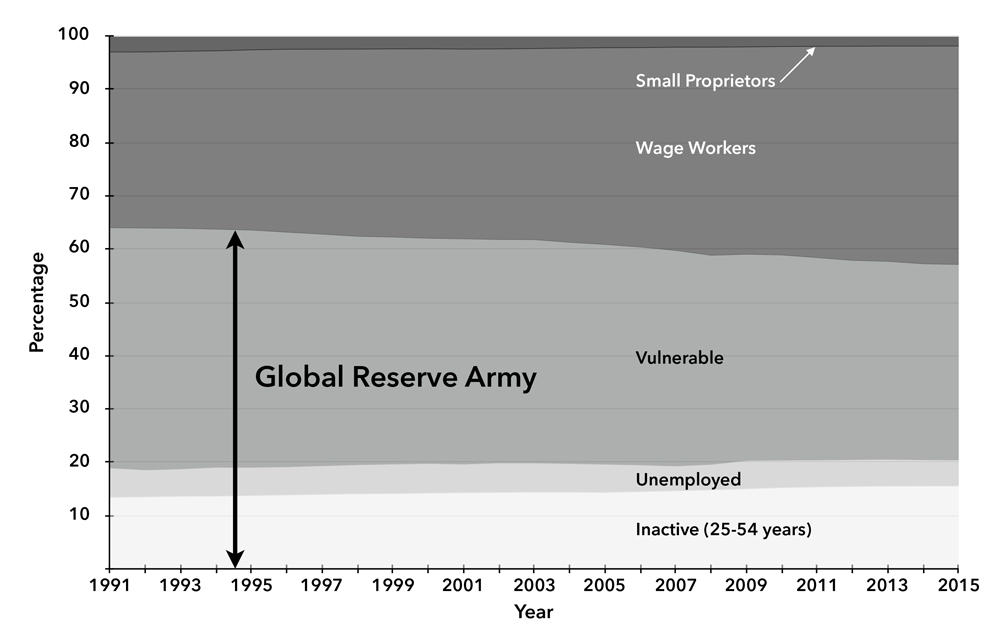
Sources: “Table R3. Status in Employment,” “Table R5. Unemployment Rate” (World and Regional Aggregates), and “Table 13. Inactivity” (Standard Query). International Labour Organization (ILO), “Key Indicators of the Labour Market (KILM),” 9th Edition (Geneva, November 2015).”
Notes: Since the figures on inactivity are given by country, they should be considered underestimates, due to the unavailability of data for certain countries and years. In the KILM 9th Edition database, the total number of countries with data on inactivity came to 193.
These figures, however, severely downplay the full extent of the global reserve army (in Marx’s conception) because those who are part-time, temporary, and contingent workers show up in the ILO figures as employed, and thus it does not take into account the increasingly precarious conditions of many of those with only a partial and insecure relation to employment.46 The share of workers globally making two dollars a day or less stood at 25 percent in 2014. Precariousness is particularly high, however, in the developing world, where the working poor (making four dollars or less per day) make up more than half of all workers. Nearly 60 percent of wage workers globally are part-time or in some form of temporary employment; in addition, over 22 percent are self-employed (often under dire conditions).47
Chart 2 shows the same ILO data with respect to the developed countries. Here the proportion of wage workers is larger, and the reserve army of labor proportionately smaller. However, what is clear from even these conservative estimates is that the reserve army in the advanced capitalist states—without counting part-time and contingent employment—is massive, constituting some 26 percent of the available workforce in 2015, and thus perpetuating a condition of precariousness. (In the developing countries the reserve army stood at 65 percent of the available workforce in 2013.) Moreover, since precariousness is often associated with part-time and contingent work, and since the shift to these work situations is rapidly increasing in the developed countries as well, its growth is much greater than the ILO data reveals.
Chart 2. Layers of the Working Class in Developed Countries, 1991–2015

Sources: See Chart 1.
Notes: The category “developed countries” is equivalent to the “high-income” category in the KILM 9th Edition database. The number of high-income countries with data on inactivity came to 65. See also the notes to Chart 1.
Conclusion
The renewed focus, particularly on the left, on precariousness constitutes a recognition of the harsh reality of capitalism, and particularly of today’s globalized monopoly-finance capital. Concepts like “precarity” and even “precariat” may have a role to play, if it means describing more fully the conditions that characterize the reserve army of labor and the increasingly tenuous hold of the active labor army on jobs and decent working conditions. Such concepts can help to demonstrate the fact, as Marx emphasized, that capital’s repeated promises to workers are false ones, and that it is now essential that the working class and society move on—in the direction of socialism. More than a century of Marxian political-economic critique allows us to appreciate the extent to which the conditions that Marx described, focusing on a small corner of Europe in the mid-nineteenth century, are now global, and all the more perilous. In the present age of what Amin has called the “generalized proletariat” versus “generalized monopoly capitalism,” the new revolutionary path that this entails lies clearly before us.48
Indeed, in contrast to Wacquant, who contends that “the precariat can only make itself to immediately unmake itself,” we need to emphasize once again the significance of the reserve army of labor within Marx’s understanding of the working class.49 Here the historic task remains what it was before—the forging of working-class unity—not in order to “universalize” the proletariat, but to transcend it.50
Notes
 See, for example, Jean-Claude Barbier, “A Comparative Analysis of ‘Employment Precariousness’ in Europe,” in Marie-Thérèse Letablier, ed.,Learning From Employment and Welfare Policies in Europe, (European Research and Policy and Economic and Social Research Council, 2004), 7–18; Leah F. Vosko,Temporary Work (Toronto: University of Toronto Press, 2000); and Judy Fudge and Rosemary Owens, eds.,Precarious Work, Women, and the New Economy(Portland, OR: Hart, 2006).
- See Leah F. Vosko,Managing the Margins (Oxford: Oxford University Press, 2010); Arne L. Kalleberg,Good Jobs, Bad Jobs (New York: Russell Sage Foundation, 2011), and “Job Quality and Precarious Work: Clarifications, Controversies, and Challenges,”Work and Occupations39, no. 4 (2012): 427–48; Martin Olsthoorn, “Measuring Precarious Employment,”Social Indicators Research 119, no. 1 (2013): 421–41; Anne Allison,Precarious Japan (Durham, NC: Duke University Press, 2013); Tayo Fashoyin et al., eds.,Vulnerable Workers and Precarious Working (Newcastle, UK: Cambridge Scholars, 2013); and Judy Fudge and Kendra Strauss, “Temporary Work, Agencies and Unfree Labour,” in Judy Fudge and Kendra Strauss, eds.,Temporary Work, Agencies and Unfree Labour (London: Routledge, 2013), 1–25.
- Guy Standing,The Precariat: The New Dangerous Class (London: Bloomsbury, 2011), 10.
- Pierre Bourdieu,Travail et Travailleurs en Algérie(Paris: Mouton, 1963).
- Pierre Bourdieu,Acts of Resistance, translated by Richard Nice (New York: New Press, 1999), 81–87, 82-83.
- Frederick Engels,The Condition of the Working Class in England (Oxford: Oxford University Press, 1993). Engels had initially introduced the reserve army perspective, though in less developed form, in his “Outlines of a Critique of Political Economy” in 1843 (Karl Marx and Frederick Engels,Collected Works, vol. 6 [New York: International Publishers, 1975], 438, 443).
- Karl Marx,Capital, vol. 1 (London: Penguin, 1976), 762–870. See the discussions in Roman Rozdolsky,The Making of Marx’s Capital (London: Pluto, 1977) 300–07, John Bellamy Foster and Robert W. McChesney, The Endless Crisis (New York: Monthly Review Press, 2012), 130—37; Joseph Fracchia, “The Capitalist Labour-Process and the Body in Pain,”Historical Materialism16, no. 4 (2008): 35–66.
- Standing,The Precariat, 7; Béatrice Appay, “‘Precarization’ and Flexibility in the Labour Process,” in Carole Thornley, Steve Jefferys, and Béatrice Appay, eds.,Globalization and Precarious Forms of Production and Employment (Cheltenham, UK: Edward Elgar, 2010), 34.
- See, for example, Grace Lee Boggs and James Boggs, “The City is the Black Man’s Land,”Monthly Review17, no. 11 (April 1966): 45; William Julius Wilson,The Truly Disadvantaged(Chicago: University of Chicago Press, 1986).
- Loïc Wacquant, “Territorial Stigmatization in the Age of Advanced Marginality,”Thesis Eleven91, no. 1 (2007): 72–73; André Gorz,Farewell to the Working Class (London: Pluto, 2001). The separation of the concepts of precariat, precariousness, and precarity off from the proletariat, so that they are frequently counterposed to the latter can be seen in some influential feminist accounts as well. Feminist theorist Judith Butler uses “precariat” to refer to “a group of people who are not only exploited workers, but whose labor is now regarded as dispensable,” closely related to Marx’s industrial reserve army (but not presented in those terms). The implication is that this serves to set the precariat off from the parts of the workforce that experience greater security (i.e., the proletariat) in sharp distinction to Marx, who saw the proletariat as the working class as a whole. Butler, moreover, implies (incorrectly) that Marx’s proletariat can be viewed in narrow economic terms. She thus seeks to distinguish the precariat from the proletariat by referring to the precariat as those who also “are targeted by war or are living in regions that have been decimated by development.” Separating “precariousness” from both labor and the proletariat, Butler describes precariousness as “a general feature of embodied life,” applicable to widely differing social situations, and sees “precarity” as an “amplification” of this “embodied” state of instability. Judith Butler, “Exercising Freedom,” interview by Eliza Kania,R/evolutions1, no. 1 (2013), http://revjournal.org.
- Richard Seymour, “We Are All Precarious—On the Concept of the ‘Precariat’ and Its Misuses,”New Left Project, February 10, 2012, http://www.newleftproject.org.
- Arne L. Kalleberg, Barbara F Reskin, and Ken Hudson, “Bad Jobs in America: Standard and Nonstandard Employment Relations and Job Quality in the United States,”American Sociological Review65, no. 2 (2000): 256–78; Kalleberg,Good Jobs, Bad Jobs; Arne L. Kalleberg, “Job Quality and Precarious Work: Clarifications, Controversies, and Challenges,”Work and Occupations39, no. 4 (2012): 440.
- See Michael Quinlan, “The ‘Pre-Invention’ of Precarious Employment: The Changing World of Work in Context,”Economic and Labour Relations Review 23, no. 4 (2012): 16.
- Engels,The Condition of the Working Class in England, 149. Punctuation of translation altered slightly in accord with Marx and Engels,Collected Works, vol. 4 (New York: International Publishers, 1975), 433.
- Engels,The Condition of the Working Class in England, 96; Karl Marx and Frederick Engels, The Communist Manifesto (New York: Monthly Review Press, 1964), 17, 72.
- Marx,Capital, vol. 1, 798.
- Marx,Capital, vol. 1, 793.
- Marx,Capital, vol. 1, 583, 795, 818, 794–95.
- Marx,Capital, vol. 1, 795, 571–72, 860, 796.
- Marx,Capital, vol. 1, 796–98, 865.
- In Marx’s analysis “manufacture” still had its original meaning of made directly by human labor, or handicraft production, while the term “machinofacture” was used by socialists to describe modern industry (corresponding to the way the word manufacture is used today). When Marx refers to “modern manufacture,” he therefore means modern handicraft production, which is distinguished both from traditional handicraft and modern industry. In his analysis of unregulated (informal) work and outwork attached to the factory system, Marx further distinguishes between modern manufacture and modern domestic labor (the latter, modern in the sense it is not to be confused with traditional domestic labor). Establishments composed mainly of women working in a small workshop (usually the home of some small employer), such as in dressmaking or millinery, clearly fit the character of modern domestic industry.
- Marx,Capital, vol. 1, 591.
- Marx,Capital, vol. 1, 602–4, 825, 863.
- Marx,Capital, vol. 1, 595–99.
- Marx,Capital, vol. 1, 353, 354–67.
- Fracchia, “The Capitalist Labour-Process and the Body in Pain,” 47; Marx,Capital, vol. 1, 618, 719, 784.
- A similar view is expressed by Bryan Palmer, “Reconsiderations of Class: Precariousness as Proletarianization,” in Leo Panitch, Greg Albo, and Vivek Chibber, eds., Socialist Register, 2014 (New York: Monthly Review Press, 2013), 40-62.
- Marx,Capital, vol. 1, 797, 807; Engels,The Condition of the Working Class in England, 96–97.
- Engels,The Condition of the Working Class in England, 97.
- Marx,Capital, vol. 1, 574–75, 579–80.
- Karl Marx,Capital, vol. 3 (London: Penguin, 1981), 345; Marx,Capital, vol. 1, 915.
- William Morris,Collected Works, vol. 23 (London: Longmans, Green, 1915), 176–77 andSigns of Change (London: Longmans, Green, 1896), 169, 187.
- William Morris,Unpublished Lectures (Detroit: Wayne State University, 1969), 232; Nick Salmon,The William Morris Chronology (Bristol, UK: Thoemmes Press, 1996), 127; David Leopold, “Introduction,” in William Morris,News from Nowhere (Oxford: Oxford University Press, 2003), xvi; E. P. Thompson,William Morris: Romantic to Revolutionary (New York: Pantheon, 1976), 613–14.
- Joyce Kolko,Restructuring the World Economy (New York: Pantheon, 1988); Fred Magdoff and John Bellamy Foster, “The Plight of the U.S. Working Class,”Monthly Review65, no. 8 (January 2014): 1–22.
- Foster and McChesney, The Endless Crisis, 4; John Bellamy Foster, Robert W. McChesney, and R. Jamil Jonna, “The Global Reserve Army of Labor and the New Imperialism,”Monthly Review63, no. 6 (2011): 4.
- An exception is in China and some countries in Asia, where workers experienced rising wages due to rapid accumulation, based on the globalization of the world economy, and the incorporation of their latent (rural worker) reserve army into production.
- Harry Braverman, Labor and Monopoly Capital (New York: Monthly Review Press, 1998); R. Jamil Jonna and John Bellamy Foster, “Beyond the Degradation of Labor: Harry Braverman and the Structure of the U.S. Working Class,”Monthly Review66, no. 5 (October 2014): 1–23; Stephen Hymer,The Multinational Corporation (Cambridge: Cambridge University Press, 1979).
- Braverman,Labor and Monopoly Capital, 29.
- Braverman,Labor and Monopoly Capital, 261–62; Harry Braverman, “The Making of the U.S. Working Class,”Monthly Review46, no. 6 (1994): 18–21.
- Jonna and Foster, “Beyond the Degradation of Labor,” 5–8.
- Hymer,The Multinational Corporation, 256–72, 262–63, 269; Marx,Capital, vol. 1, 764.
- Hymer,The Multinational Corporation, 263, 259, 271.
- Fred Magdoff, “A Precarious Existence: The Fate of Billions?”Monthly Review 55, no. 9 (February 2004): 1–14; Mike Davis,Planet of Slums(London: Verso, 2007); “World Employment and Social Outlook: The Changing Nature of Jobs,” (Geneva: International Labour Organization [ILO], 2015), 28.
- On the question of a New International, see István Mészáros,The Necessity of Social Control(New York: Monthly Review Press, 2015), 199–217.
- Hymer,The Multinational Corporation, 270–71.
- Foster, McChesney, and Jonna, “The Global Reserve Army of Labor,” 19–26.
- “World Employment and Social Outlook,” 28, 13, 39. Note: these data are based on the latest year available for the given country.
- Samir Amin, Three Essays on Marx’s Value Theory (New York: Monthly Review Press, 2013), and The Implosion of Contemporary Capitalism (New York: Monthly Review Press, 2013).
- Wacquant, “Territorial Stigmatization,” 72–73.
- For Marx, the goal of the working-class movement was not the universalization of the proletariat but its “final emancipation…the ultimate abolition of the wages system” (Capital, vol. 1, 62).
