
Introduction
With the rise of Donald Trump to the office of President of the United States, politics has descended, like never before, to a theater of the absurd. Unbridled anti-intellectualism, deception, and “vindictive chaos” offer the rhetorical tools for repeating elements of a morally reprehensible past in the guise of “making America great again.” Advancing an aggressively alarmist agenda bolstered by “alternative facts,” the Trump administration has unleashed a type of anti-politics that unburdens people of any responsibility to challenge, let alone collectively transform, the fundamental precepts of a society torn asunder by blatant misogyny, massive inequality, open bigotry, and violence against immigrants, Muslims, and poor minorities of color.1
In the new age of Trump, justice becomes the enemy of democratic leadership, and the capacity to name this collectively agreed upon reality recedes with each assertion of fakery in infinite repetition. When evidence, science, and reason are purged of their legitimacy, politics capitulates to the venomous ideals, policies, and practices one associates with a totalitarian past. Cast into a political, existential, and ethical crisis in which it now finds itself immersed, the United States mimics a failed state as the credibility of its democratic institutions and the trustworthiness of its leadership are called into question on the global stage. Despite his populist posturing, Trump’s contempt of democratic processes is matched by his commitment to the market and economic policies that favor the financial elite. In short, as the Washington Post observed, Trump is a “unique threat to democracy,” and a triumph for the forces of nativism, racism, and misogyny.2
Trump’s ascendancy in U.S. politics has made visible a plague of deep seated civic illiteracy, a corrupt political system, and a contempt for reason that has been decades in the making; it also points to the withering of civic attachments, the decline of public life, and the use of violence and fear to shock and numb everyday people. Galvanizing his base of true-believers in post-election rallies, the country witnesses how politics is transformed into a spectacle of fear, divisions, and disinformation. Under President Trump the scourge of twentieth-century fascism has returned as neo-fascism, not only in the menacing plague of populist rallies, fear-mongering, hate, and humiliation, but also in an emboldened culture of war, militarization, and violence that looms over society like a rising storm.
Cultural memory should always serve as a mode of moral witnessing and protection against tyranny. Yet, history, as Marx observed, sometimes repeats itself with farcical vengeance. When it does, it signals a crisis of memory, politics, and civic literacy. This is particularly true in the current moment, as the return of menacing ghosts of the past has been abetted by a comforting silence that the culture of consumption, privatization, and individualization produces in the space that politics once occupied.
The reality of Trump’s election may be the most momentous development of the age, because of its enormity and the shock it has produced. The whole world is watching, pondering how such a dreadful event could have happened. How have we arrived here? Albert Camus understood this threat well. He warned us about how the plague of fascism can reappear in updated forms. For Camus, the disease of fascism could only be fought with the antibody of consciousness, one that embraced the past as a way of protecting the present and the future against the unimaginable damage now forgotten. The words that form the concluding paragraph of The Plague are as relevant today as they were when they were written more than half a century ago. Camus writes:
[As] he listened to the cries of joy rising from the town, Rieux remembered that such joy is always imperiled. He knew what those jubilant crowds did not know but could have learned from books: that the plague bacillus never dies or disappears for good; that it can lie dormant for years and years in furniture and linen chests; that it bides its time in bedrooms, cellars, trunks, and bookshelves; and that perhaps the day would come when, for the bane and the enlightening of men, it would rouse up its rats again and send them forth to die in a happy city.3
What follows is an attempt to assert the significance of historical memory as fundamental to the preservation of democracy in the face of an unprecedented shift towards neo-fascism. Reviving the memory of a dystopian past strikingly represented in Orwell’s and Huxley’s fiction is a way to understand, perhaps the only way left for us to fully grasp, the present descent of the United States into an authoritarian nightmare. Focusing on their engagement with authoritarian visions, language, truth, and lies offers a critical arsenal of defense against a Trump era of tweets and news fakery, and the more generalized and more lethal attacks on reason, science, and liberal modernity.
Orwell’s Nightmare
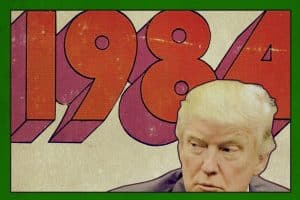
Before we credit Trump with using the great novel as his codebook, it is actually the case that George Orwell’s terrifying vision of a totalitarian society has been a waking dream in the United States for many years. For instance, 1984 provided a stunningly prophetic image of the totalitarian machinery of the surveillance state that was brought to life in 2013 through Edward Snowden’s exposure of the mass spying conducted by the United States National Security Agency. Orwell’s genius was not limited to this predictive capacity alone. In addition, his fiction explores how modern democratic populations are won over by authoritarian ideologies and rituals, revealing how language specifically functioned in the service of deception, abuse, and violence. He warned in exquisite and alarming detail how “totalitarian practice becomes internalized in totalitarian thinking.”4 For Orwell, the mind-controlling totalitarian state took as its first priority a war against what it called “thought crimes,” nullifying opposition to its authority not simply by controlling access to information but by undermining the very basis on which critical challenges could be waged and communicated. Orwell illustrated his point by providing examples of language that undermined the critical formative culture necessary for producing thinking citizens central to any healthy democracy. In recognizing how language fundamentally structures as much as it expresses thought, Orwell made clear how language could be distorted and circulated to function in the service of violence, deception, and misuse, and in doing so utterly collapse any distinction between good and evil, truth and lies.
According to Orwell, totalitarian power drained meaning of any substance by turning language against itself, exemplified infamously through his Ministry of Truth which dissolved politics into a pathology by promoting slogans such as: “War is Peace,” “Freedom is Slavery,” and “Ignorance is Strength.” Hannah Arendt added theoretical weight to Orwell’s fictional nightmare by arguing that neo-fascism begins with a contempt for critical thought and that the foundation for authoritarianism lies in a kind of mass thoughtlessness in which a citizenry “is deprived not only of its capacity to act but also its capacity to think and to judge.”5
The intersection, if not merger, of popular culture and U.S. politics was evident in the frenzied media circus that took place after Trump assumed the presidency, a fact not lost on the U.S. public. Orwell’s novel 1984 surged as the number one best seller on Amazon.com both in the United States and Canada. This followed two significant political events. First, Kellyanne Conway, Trump’s advisor, in a move reminiscent of the linguistic inventions of Orwell’s Ministry of Truth coined the term “alternative facts” to justify why press secretary Sean Spicer lied in advancing disproved claims about the size of Trump’s inauguration crowd.6 With apologies to his late father—a pastor—Bill Moyers has called Conway the “Queen of Bullshit.”7 The concept of “alternative facts” or more precisely what should be called outright lies, is an updated term of what Orwell called “Doublethink,” in which people blindly accept contradictory ideas or allow truth to be subverted in the name of unquestioned commonsense.
Second, almost within hours of his presidency, Trump penned a series of executive orders that compelled Adam Gopnik, a writer for the The New Yorker, to rethink the relevance of 1984. He had to go back to Orwell’s book, he writes, “Because the single most striking thing about [Trump’s] matchlessly strange first week is how primitive, atavistic, and uncomplicatedly brutal Trump’s brand of authoritarianism is turning out to be.”8
Unfortunately, the machinery of remolding, manipulation, and distortion has gained enormous traction at the present time in U.S. society, especially under the Trump administration. In this Orwellian universe, facts have been purged of their legitimacy, and the distinction between right and wrong disappears, promoting what Viktor Frankl once called “the mask of nihilism.”9 In this world view, there are only winners and losers. Under such circumstances, “greed, vengeance and gratuitous cruelty aren’t wrong, but are legitimate motivations for political behavior.”10 This is a discourse that reinforces a future in which neo-fascism thrives and democracies die. It is the discourse of a dystopian society marked by a deep-seated anti-intellectualism intensified by the incessant undermining and collapse of civic literacy and civic culture. Offering no room for deciphering fact from fiction, the flow of disinformation works to dismantle self-reflection while it serves to infantilize and depoliticize large segments of the polity.
As Orwell often remarked, historical memory is dangerous to authoritarian regimes because it has the power to both question the past and reveal it as a site of injustice. Currently, Orwell’s machinery of organized forgetting is reinforced by a burgeoning landscape of mega-malls and theme parks, media driven spectacles of violence, and a culture of consumerism, self-interest, and sensationalism for those who can afford participation. For the rest, the ongoing financial starvation and evisceration of public schools and public universities ensures that the lessons of history are neutered or displaced altogether by an instrumentalist curriculum whose hallmark is job-ready skills. In Orwell’s Ministry of Truth, it is a crime to read history against the grain. In fact, history is falsified so as to render it useless as a crucial pedagogical practice both for understanding the conditions that shape the present and for remembering what should never be forgotten. As Orwell makes clear, this is precisely why tyrants consider historical memory dangerous; history can readily be put to use in identifying present-day abuses of power and corruption.
The Trump administration offered a pointed example of this Orwellian principle when it recently issued a statement regarding the observance of International Holocaust Remembrance day. In the statement, the White House refused to mention its Jewish victims, thus erasing them from a monstrous act directed against an entire people. Politico reported that the official White House “statement drew widespread criticism for overlooking the Jews’ suffering, and was cheered by neo-Nazi website the Daily Stormer.”11Accounts of these events read like passages out of Orwell’s 1984 and speak to what the historian Timothy Snyder calls the Trump administration’s efforts to look to authoritarian regimes of the 1930s as potential models.12
This act of erasure is but another example of the willingness of the Trump administration to empty language of any meaning, a practice that constitutes a flight from historical memory, ethics, justice, and social responsibility. Under such circumstances, government takes on the workings of a dis-imagination machine, characterized by an utter disregard for the truth, and often accompanied, as in Trump’s case, by “primitive schoolyard taunts and threats.”13 In this instance, Orwell’s “Ignorance is Strength” materializes in the Trump administration’s weaponized attempt not only to rewrite history, but also to obliterate it, all of which contributes to what might be called a “drugged complacency.”14 Trump’s contemptuous and boisterous claim that he loves the uneducated and his willingness to act on that assertion by flooding the media and the wider public with an endless proliferation of peddled falsehoods reveal his contempt for intellect, reason, and truth. As the master of phony stories, Trump is not only at war with historical remembrance, science, and rationality, he also wages a demolition campaign against democratic ideals by unapologetically embracing humiliation, racism, and exclusion for those he labels as criminals, terrorists, and losers, categories equated with Muslims, Mexicans, women, the disabled, and the list only grows. As John Wight observes, Trump’s language of hate “is redolent of the demonization suffered by Jewish people in Germany in the 1930s, which echoes a warning from history.”15
Orwell’s point about duplicitous language was that all governments lie. The rhetorical manipulation definitive of Orwellian language is not distinctive to the Trump administration, though it has taken on an unapologetic register in redefining it and deploying it with reckless abandon. The draconian use of lies, propaganda, misinformation, and falsification has a long legacy in the United States, with other recent examples evident under the presidency of George W. Bush. Under the Bush-Cheney administration, for example, “doublethink” and “doublespeak” became normalized as state sponsored torture was shamelessly renamed as “enhanced interrogation.” Barbaric state practices such as sending prisoners to countries where there were no limits on torture were framed in the innocuous language of “rendition.”16Such language made a mockery of policy discourse and eroded public engagement. It also contributed to the transformation of institutions that were meant to limit human suffering and misfortune, and protect citizens from the excesses of the market and state violence, into something like their opposite.17
The attack on reason, dissent, and truth itself finds its Orwellian apogee in Team Trump’s endless proliferation of lies: including claims that China is responsible for climate change, former President Obama was not born in the United States, the murder rate in the United States is at its highest in 47 years, and voter fraud prevented Trump from winning the popular vote for the presidency. Such lies, big and small, do not function simply as mystification; they offer justification for aggressive immigration crackdowns, for effectively silencing the Environmental Protection Agency, and for trying to undo Obamacare. Too often the relentless fabrications serve to distract the press, focusing their energies on exposing the untrustworthiness of the person and not on the symbolic, legal, and material violence that such pronouncements and harsh policies invariably unleash.
Allow me to underscore one more striking example. In moments that speak to an alarming flight from moral and social responsibility, Trump has adopted terms strongly affiliated with the legacy of anti-Semitism and Nazi ideology. For example, historian Susan Dunn refers to his use of the phrase “America First” as a “sulfurous expression” connected historically to “the name of the isolationist, defeatist, anti-Semitic national organization that urged the United States to Appease Adolf Hitler.” It is also associated with its most powerful advocate, Charles Lindbergh, a notorious anti-Semite who once declared that the United States’ greatest internal threat came from Jews who posed a danger to the nation because of their “large ownership and influence in our motion pictures, our press, our radio, and our government.”18Though Trump denies he has given a platform to neo-Nazi groups, let alone a White House senior advisor, the shocking uptick in bomb threats to dozens of Jewish community centres across the United States can hardly be said to be coincidental.19
Once he was elected to the presidency, Trump took ownership of the notion of “fake news,” inverting its original usage as critique of his perpetual lying and redeploying it as a pejorative label aimed at journalists who criticized his policies. Even Trump’s inaugural address was filled with lies about rising crime rates and the claim of unchecked carnage in the United States, though crime rates are at historical lows. His blatant disregard for the truth reached another high point soon afterwards with his nonsensical and false claim that the mainstream media lied about the size of his inaugural crowd, or more recently his assertion that the leaks involving his national security adviser were “real” but the news about them was “fake.” The Washington Post fact-checked Trump’s address to the joint session of Congress and listed 13 of his most notable “inaccuracies” or what can rightfully be called lies.20 Trump’s penchant for lying and his irrepressible urge to tell them are more than what Gopnik calls “Big Brother crude” and the expression of a “pure raging authoritarian id,” they also speak to an effort to undermine freedom of speech and truthfulness as core democratic values.21 Trump’s lies signal more than a Twitter fetish aimed at invalidating the work of reason and evidence-based assertions. Trump’s endless threats, fabrications, outrages, and “orchestrated chaos,” produced with a “dizzying velocity,” also point to a strategy for asserting power, while encouraging if not emboldening his followers to think the unthinkable ethically and politically.22 While it may be true that all administrations lie, what is unique to the Trump administration as Charles Sykes, a former conservative radio host, observes “is an attack on credibility itself.”23
White Supremacy and the Politics of Racial Cleansing
Echoes of earlier authoritarian societies are not only audible in Trump’s falsehoods, petulance, and crudeness but also in his slash-and-burn policies and his less discussed embrace of elements of white supremacy. For example, his racism was on full display in the issuance of two executive orders banning citizens from seven Muslim-majority countries—Iran, Iraq, Syria, Yemen, Somalia, Sudan, and Libya. Trump’s immigration orders further threaten the security of the United States given their demagogic design and rhetoric of barring by serving as a powerful recruiting tool for terrorists.
The conditions permitting such an executive order to be thinkable, let alone entered into policy, not only signal a society that has stopped questioning itself, but also points to its embrace of a form of social engineering that is once again being constructed around an imagined assault (alleged terrorists from the countries named in the ban were accountable for zero U.S. deaths) that legitimates a form of state sponsored racial and religious purging driven by an attempt to create a white Christian nation governed by biblical values.24 Fear is now managed and buttressed by normalizing the claims of white supremacists and militant right-wing extremists that racial purification should be accepted as a general condition of society and its securitization.
Under Trump’s regime of hatred, cruelty, and misery, massive exploitation associated with neoliberal capitalism merges with a politics of exclusion and disposability. Racial cleansing based on generalized notions of identity echoes the sordid principles of earlier policies of prohibition and eventual extermination that we saw in past regimes. This is not to suggest that Trump’s immigration policies have risen, as yet, to the level of genocidal vitriol and sordid extermination policies of totalitarian regimes that gave birth to unimaginable horrors and intolerable acts of mass violence.25 But it is to suggest that they contain elements of a past totalitarianism that “heralds a possible model for the future.”26 What I am arguing is that this form of radical exclusion based on the denigration of Islam as a closed and timeless culture marks a terrifying entry into a political experience that suggests that older elements of fascism are crystallizing into new forms.
The malleability of truth has made it easier for governments, including the Trump administration to wage an ongoing and ruthless assault on the immigrants, social state, workers, unions, higher education, students, poor minorities, and any vestige of the social contract. Under the Trump administration, the principles of casino capitalism, a permanent war culture, the militarization of everyday life, the privatization of public wealth, the elimination of social protections, and the deregulation of economic activity will be accelerated. As democratic institutions decay, Trump does not even pretend to defend the fiction of democracy. He only recites his own fictions all the while annihilating the truth and destroying the possibility of critical thinking and analysis.
There can be little doubt about the ideological direction of the Trump administration given his appointment of billionaires, generals, white supremacists, representatives of the corporate elite, and general incompetents to the highest levels of government. Public spheres that once offered at least the glimmer of progressive ideas, enlightened social policies, non-commodified values, and critical dialogue and exchange have and will be increasingly commercialized—or replaced by private spaces and corporate settings whose ultimate fidelity is to increasing profit margins. What we are witnessing under the Trump administration is more than an aesthetics of vulgarity as the mainstream media sometimes suggest. Instead, we are observing a politics fueled by a market-driven view of society that has turned its back on the very idea that social values, public trust, and communal relations are fundamental to a democratic society. It is to Orwell’s credit that in his dystopian view of society, he opened a door for all to see a “nightmarish future” in which everyday life becomes harsh, an object of state surveillance, and control—a society in which the slogan “ignorance becomes strength” morphs into a guiding principle of the highest levels of government, mainstream media, education, and the popular culture.
Huxley’s World of Manufactured Ignorance
Aldous Huxley’s Brave New World offers a very different and no less critical register to the landscape of state oppression, one that is especially relevant with the rise of Donald Trump, the ever-present Reality TV star performer and the imperial wizard of the spectacle and a fatuous celebrity culture, to the head of government, director of the executive branch and commander-in-chief of the U.S. armed forces. Huxley believed that social control and the propagation of ignorance would be introduced by those in power through a vast machinery of manufactured needs, desires, and identifications. For him, oppression took the form of voluntary slavery produced through a range of technologies, refined forms of propaganda, and massive forms of manipulation and seduction. Accordingly, the real drugs of a control society and social planning in late modernity were to be found in a culture that offers up immediate pleasure, sensation, and gratification. This new mode of persuasion seduced people into chasing commodities, and infantilized them through the mass production of easily digestible entertainment, mass rallies, and a politics of distraction that dampened, if not obliterated, the very possibility of thinking itself. For Huxley, the subject had lost his or her sense of agency and had become the product of a scientifically and systemically manufactured form of idiocy and conformity.
If Orwell’s dark image is the stuff of government oppression—“a boot stamping on a human face—forever,” Huxley’s dystopia is the stuff of entertaining diversions, staged spectacles, and a cauterizing of the social imagination. For instance, as public schools are defunded to the point where they serve mostly a warehousing function, they no longer provide a bulwark against civic illiteracy. In addition, the educational function of wider cultural apparatuses is now present in the new mechanisms of social planning and engagement found in the hallucinatory power of a mind-deadening entertainment industry, the culture of extreme sports, and other forms of public pedagogy, which extend from Hollywood movies and video games to mainstream television, news, and the social media. These cultural apparatuses are the echo chambers that produce spectacles of extreme violence, representations of hyper-masculinity, the infantilization produced by consumer culture and frenzied shoppers, and the power of a fatuous celebrity culture encouraging the worship of lifestyles, all of which confer enormous authority on the likes of the rich and infamous, such as the dreadful Kardashians.
But behind Trump’s clownish persona, the amalgam of Trump’s blatant contempt for the truth, his willingness to taunt and threaten in his inaugural address, and his rush to enact a series of regressive executive orders, the ghost of fascism reasserts itself with a familiar mix of fear and revenge. Unleashing promises he had made to his angry, die-hard ultra-nationalists, and white supremacist supporters, the billionaire populist played on the desires and desperation of a range of groups whom he believes have no place in U.S. society. The underlying ignorance, cruelty, and punishing, if not criminogenic, intent behind such “demolition crew” policies was amplified when Trump suggested that he intended to pass legislation amounting to a severe reduction of environmental protections. Little did his cheering crowds suspect that they would be paying for the wall through massive taxation on imports from Mexico. He also asserted his willingness to resume the practice of state sponsored torture, despite warnings from military experts of serious blowback for Americans, and deny federal funding to those cities willing to provide sanctuary to illegal immigrants. And this was just the beginning. The financial elite now find their savior in Trump as they will receive more tax cuts, and happily embrace minimal government regulations, while their addiction to greed spins out of control. Should we be surprised?
As Huxley predicted, the memory of totalitarian methods of popular seduction, with its ready supply of simplistic answers, its vulgar spectacles, and its taste for massification, hawking fear, and its exploitation of the desire for strong leaders, has faded in a society beset by an amnesiac producing culture of immediacy, sensationalism, and mindless entertainment. Under such circumstances, it is difficult to misjudge the depth and tragedy of the collapse of civic culture and democratic public spheres. For those outside the influence of a consumer culture, that depoliticizes and infantilizes, there is a permanent war culture that trades in fear and paranoia concerning enemies at home and abroad while maintaining the largest prison system in the world “with 2.2 million people in jail and more than 4.8 million on parole.”27
Another shocking and revelatory indication of the repressive fist of neo-fascism in the Trump regime took place when Trump’s chief White House right-wing strategist, Steve Bannon, stated in an interview that “the media should be embarrassed and humiliated and keep its mouth shut and just listen for awhile…. You’re the opposition party. Not the Democratic Party.… The media is the opposition party. They don’t understand the country.” Unsurprisingly, Bannon also referred to himself in the same interview as “Darth Vader.”28 A more appropriate comparison would have been to Joseph Goebbels, the Reich Minister of Propaganda in the Third Reich. This is more than an off-the-cuff angry comment. It is a blatant refusal to see the essential role of a robust and critical media in a democracy. In the views of Trump and Bannon, real journalism is denounced, especially when it functions as “the enemy of injustice, corruption, oppression and deceit.”29
How else to explain a U.S. president calling journalists “among the most dishonest human beings on earth,” going so far as to claim that critical media are “the enemy of the American people”?30 These are ominous and alarming comments that not only suggest that journalists can be tried with treason but also echo previous fascist totalitarian regimes which waged war on both the press and democracy itself. As Roger Cohen observes:
“Enemy of the people,” is a phrase with a near-perfect [fascist] totalitarian pedigree deployed with refinements by the Nazis…. For Goebbels, writing in 1941, every Jew was “a sworn enemy of the German people.” Here the people’ are an aroused mob imbued with some mythical essence of nationhood or goodness by a charismatic leader. The enemy is everyone else. Citizenship, with its shared rights and responsibilities, has ceased to be.31
A public shaped by manufactured ignorance and indifferent to the task of discerning the truth from lies largely applauded this expression of totalitarian bravado, especially when it incites hatred and violence. Trump’s call to build a wall between the United States and Mexico and his consideration of using the National Guard to round up illegal immigrants arouse applause among his followers.32 So does his penchant for disparaging all critics as losers, which is reminiscent of the ways failed contestants were treated on his reality TV show, The Apprentice.33 Dissenting journalists and others are refused access to government officials, derided as purveyors of fake news, become objects of retribution while being told to shut up, and, in the course of being symbolically fired, are relegated to zones of terminal exclusion.34
Under the new authoritarian state, perhaps the gravest threat one faces is not simply being subject to the dictates of “arbitrary power” but when far too few people seem interested in contesting such undemocratic use of power. It is precisely the poisonous and pervasive spread of political indifference that puts at risk the fundamental principles of justice and freedom which lie at the heart of a robust democracy. Trump’s presidency signals the unimaginable in that the democratic imagination has been transformed into a public relations machine that marshals its inhabitants into the neoliberal dream worlds of obedient subjects, babbling consumers, and armies of exploitative labor. This is the brave new surveillance/punishing state that merges Orwell’s Big Brother with Huxley’s mind-altering modes of entertainment, education, and propaganda.
The question now confronting us is what will U.S. society look like under a Trump administration? For those not marked for terminal exclusion and disposability, it may well mimic Huxley’s nightmarish world in which corruption is rampant, ignorance is a political weapon, and pleasure is utilized as a form of control, offering nothing more than the swindle of fulfillment, if not something more self-deluding and defeating. Both Huxley and Orwell presented their visions of closed dystopian societies as warnings, as critical frameworks to shake us out of our complacency, because they believed that avoiding a catastrophic future necessitated a more open society disinclined to model itself after the horrific images they so brilliantly imagined. Orwell believed in the power of those living under such oppression to imagine otherwise, to think beyond the dictates of the authoritarian state and to offer up spirited forms of broad-based resistance willing to reclaim the reigns of political emancipation. For Huxley, there was hope in a pessimism that had exhausted itself, one which left people to reflect on the implications of a totalitarian power that controls pleasure as well as pain, and the utterly disintegrated social fabric that would be its consequence. For Orwell, optimism had to be tempered by a sense of educated hope, one that enabled people to expand a narrow conception of self-interest, place themselves in the bigger picture, connect their individual well-being to the well-being of others, and make a commitment to struggle for an alternative future. History is open and only time will tell who was right.
Democracies in Exile
Democracy in the United States is under siege, but the forces of resistance are mobilizing around a renewed consciousness in which civic courage and the ethical imagination are being realized through mass demonstrations in which individuals are putting their bodies on the line once again, refusing Trump’s machinery of misogyny, nativism, and white supremacy. Airports are being occupied, people are demonstrating in the streets of major cities, town halls have become sites of resistance, universities are being transformed into sanctuaries to protect undocumented students, and liberal and progressive politicians are speaking out against the emerging neo-fascism. Democracy may be in exile in the United States and imperiled in Europe and other parts of the globe, but the spirit that animates it is far from defeated. Once again the public memory of prophecy is in the air echoing Martin Luther King Jr’s call “to make real the promise of democracy.”
In what follows, I want to offer one strategy for resistance by developing an idea that I call “democracies in exile.” This concept is intended to provide a rhetorical referent and material space that refuses the sense of expulsion, isolation, and punishment that derives from being metaphorically (or materially) barred from one’s own country and unites the ideal and promise of an insurrectional democracy with systemic forms of political engagement. It offers a model of critical consciousness and an “ethical space where we encounter the pain of others and truly reflect on its significance to a shared human community.”35 Such sanctuaries do more than simply offer refugees protection and services such “as emergency shelters, recreation, public transit, libraries, food banks, and police and fire services without asking questions about their status.”36 They also point to and beyond the identification of structures of domination and repression in search of new understanding and imaginative response to the ominous forces at work in U.S. society marked by a collapse of civic culture, literacy, and shared citizenship. Such spaces constitute new apparatuses for people to learn together, to engage in extended dialogue, and to fashion political formations in the service of fighting for political, economic, and social justice and transformation. This radically expanded notion of sanctuary takes seriously the fact that no democracy can survive without informed citizens.
Democracies in exile are grounded in a discourse of critique and hope, self-reflection, and a comprehensive understanding of politics. As a mode of critique, they offer spaces for critical dialogue, collaboration, and what it means to rethink the significance of politics. As a discourse of hope, they offer the possibility of organizing new levels of resistance designed to dismantle a society that is emulating totalitarian conditions given its attack on dissent, the social contract, and individuals and groups who are being marked as deficient or disposable because of their religion, race, or country of origin. These models for democracy are open collectivities joined in the spirit of compassion and justice; they mark the antithesis of Trump’s society of walls, punitive laws, and gated communities. They signal a mode of witnessing and organized resistance inspired by a renewed commitment to justice and equality. This is a spirit of redemption matched by mass protests such as the recent Day without Immigrants strike and the 4.2 million people who took to the streets in protest on Trump’s second day in office. In both cases, the aim was “to demonstrate the productive power of the people” in the struggle to take back democracy.37
Democracies in exile offer the opportunity to fuse popular movements and traditional sites of struggle such as unions, churches, and synagogues. For example, churches throughout the United States are using private homes in their parishes as shelters while at the same time “creating a modern-underground railroad to ferry undocumented immigrants from house to house or into Canada.”38 Hiding and housing immigrants is but one important register of political resistance that such sanctuaries can provide. Organizations such as the Protective Leadership Institute and the State Innovation Exchange are fighting back against conservative state legislation by modeling progressive legislation, putting ongoing pressure on politicians, educating people on issues and how to employ the skills for disruptive political strategies, and building “a progressive power base in the states.”39 In addition, cities such as New York have proclaimed themselves as sanctuary cities and students in “as many as 100 colleges and universities across the country” have held protests “demanding their schools become sanctuary campuses.”40
Such outposts offer new models of collaboration, united by a perpetual striving for a more just society. As such, they join in solidarity and in their differences, mediated by a respect for the common good, human dignity, and decency. Together they resist a demagogue and his coterie of reactionaries who harbor a rapacious desire to concentrate power in the hands of a financial elite and the economic, political, and religious fundamentalists who seek to amass power by any means necessary. This mode of opposition connects the task of both raising consciousness and mobilizing against the suffocating ideologies, worldviews, and policies that are driving the new species of fascism. These alternative spaces and new public spheres that reflect what Sara Evans and Harry Boyte call “free spaces,” which take on the task of ongoing community education designed to revitalize civic education and civic courage.41
The language of exile signals the need for diverse institutions and public spheres to organize against the poisonous legacies and neo-fascist strictures of racial purity, economic oppression, and sexual violence that are still with us, and rejects the toxic reach of a government dominated by authoritarians with their legions of conservative lawyers, think tanks, pundits, and intellectual thugs. These spaces for resistance make clear that we will demand our right of return to a country and a vision that has served as beacons of hope for centuries, energized in our rejection of all forms of exploitation and racial cleansing.
What might it mean to create public spheres and institutions that represent models of a democracy in exile—sanctuaries that preserve the ideals, values, and experiences of a radical democracy? What might it mean, to imagine diverse democratic landscapes of exile as Islands of freedom that inspire and energize young people, educators, workers, artists, and others to engage in political and pedagogical forms of resistance that are disruptive, transformative, and emancipatory? What might it mean to create multiple protective spaces of resistance that would allow us to think critically, ask troubling questions, take risks, transgress established norms and fill the spaces of everyday life with ongoing acts of non-violent opposition? What will it take to create entire cities whose diverse institutions function as sanctuaries those who fear expulsion and state terror? How might we together generate modes of coordinated resistance that challenge this new and terrifying horizon of neo-fascism that has overshadowed the ideals of an already fragile and wounded democracy?
The concept of democracies in exile is not a prescription or rationale for cynicism, nor is it a retreat from one’s role as an informed and engaged citizen. On the contrary, it is a space of energized hope where the realities of neo-fascism along with its racist, morally obscene, and politically death-dealing practices can be revealed, analyzed, challenged, and end. The United States now occupies an historical moment in which there will likely be an overwhelming acceleration of violence, oppression, lawlessness, and corruption. These are truly frightening times that must be confronted if a democratic future is not to be cancelled out. This certainly raises questions about what role educational institutions should take in the face of impending tyranny.
One of the challenges facing the current generation of educators, students, progressives, and other concerned citizens is the need to address the role they might play in the face of neo-fascism. At the heart of such efforts is the question of what education should accomplish in a democracy under siege? What work do educators have to do to create the economic, political, and ethical conditions necessary to endow young people and the general public with the capacities to think, question, doubt, imagine the unimaginable, and defend education as essential for inspiring an informed thoughtful citizenry integral to the existence of a robust democracy? In a world in which there is an increasing abandonment of egalitarian and democratic impulses and the erasure of historical memory, what will it take to educate young people and the broader polity to learn from the past and understand the present in order to challenge authority and hold power accountable?
One option is for universities to become sanctuaries for democracies in exile. That would mean creating public spaces not only for the most vulnerable, illegal immigrants, and those deemed disposable, but also to serve as beacon for equipping students and others with the knowledge, skills, experiences, and values they need to participate in the struggle to keep the ideal and practices of democracies alive. For many universities, this would mean renouncing their utterly instrumental approach to knowledge, empowering faculty to connect their work with important social issues, refusing to treat students as customers, and choosing administrative leaders who have a vision rooted in the imperatives of justice, ethics, social responsibility, and democratic values.42 The culture of business has become the business of education and to be frank it has corrupted the mission of too many universities. It is necessary for students, faculty, and others to reverse this trend at a time when the dark shadows of neo-fascism are engulfing so much of the planet, threatening not only spaces for critical inquiry but also democracy itself.
We must also ask, what role might education, historical memory, and critical pedagogy have in the larger society in which the social has been individualized, political life has been collapsed into the therapeutic, and education has been reduced to either a private affair or a kind of algorithmic mode of regulation in which everything is reduced to a desired empirical outcome? What role could a resuscitated critical education play in challenging the deadly neoliberal claim that all problems are individual, when the roots of such problems lie in larger systemic forces? What role might universities fulfill in preserving and scrutinizing cultural memory in order to ensure our current generation and the next are on the right side of history? Students and others need the historical knowledge, critical tools, and analytic skills to be able to understand the underlying roots and forces that gave rise to Trump’s ascendency as the President of the United States. Understanding how “the possible triumph in America of a fascist-tinged authoritarian regime” is posed to destroy “a fragile liberal democracy” is the first step towards a viable and sustained resistance.43 What cannot be forgotten is that this an authoritarian regime that draws from a fascist history that unleashed nothing short of large-scale terror, violence, and the death of civic imagination.
Manufactured ignorance erases history and in that space it is easy to forget that Trump is not simply the product of the deep-seated racism, attack on the welfare state, and the free-market frenzy that has driven the Republican Party since the 1980s. He is also the result of the liberal elite and the Democratic Party that separated itself from the needs of working people, minorities of color, and young people by becoming nothing more than the party of the financial elite. The neoliberal elite of the Democratic Party who are so anxious to condemn Trump and his coterie as demagogic and authoritarian are the same people who gave us the surveillance state, bailed out Wall Street, ushered in the mass incarceration state, and punished whistle blowers. Chris Hedges is right in arguing that the Democratic Party is an appendage of the market. Their embrace of “neoliberalism and [refusal] to challenge the imperial wars empowered the economic and political structures that destroyed our democracy and gave rise to Trump.”44 The only answer the Democratic Party has to Trump is to strike back when he overreaches and make a case for the good old days when they were in power. What they refuse to acknowledge is that their policies help render possible Trump’s victory and that what they share with Trump is their mutual support for bankers, the rule of big corporations, neoliberalism, and the assumption that capitalism and democracy are synonymous. What is needed is a new understanding of political, a new democratic socialist party, and a radical restructuring of politics itself.
At the same time, any confrontation with the current historical moment has to be contoured with a sense of hope and possibility so that intellectuals, artists, workers, educators, and young people can imagine otherwise in order to act otherwise. While many countries have transformed into what Stanley Aronowitz calls a repressive “national security state,” there are signs that neo-fascism in its various versions is currently being challenged, especially by young people, and that the radical imagination is still alive.45 No society is without resistance, and hope can never be reduced to merely an abstraction. Hope has to be informed, militant, and concrete. As I have written elsewhere:
Progressives with structural power need desperately to join with those who have been written out of the script of democracy to rethink politics, find a new beginning and develop a vision that is on the side of justice and democracy. Hope in the abstract is not enough. We need a form of militant hope and practice that engages with the forces of authoritarianism on the educational and political fronts so as to become a foundation for what might be called hope in action—that is, a new force of collective resistance and a vehicle for anger transformed into collective struggle, a principle for making despair unconvincing and struggle possible.46
Nothing will change unless people begin to take seriously the deeply rooted cultural and subjective underpinnings of oppression in the United States and what it might require to make such issues meaningful in both personal and collective ways, in order to make them critical and transformative. This is fundamentally a pedagogical as well as a political concern. As Charles Derber has explained, knowing “how to express possibilities and convey them authentically and persuasively seems crucially important” if any viable notion of resistance is to take place.47 The current regime of neo-fascism cultivates support—to call this indoctrination would be far too simplistic—through a new and pervasive sensibility in which people surrender themselves (believing it to be in their interests) to both casino capitalism and a general belief in its call for amplified security, a punishing notion of law and order, and a range of domestic policies that echo the bigotry, racism, and script of racial purification of earlier fascist regimes. This updated version of U.S. fascism does not simply repress independent thought, but constitutes new modes of thinking reproduced and reinforced through a diverse set of cultural apparatuses ranging from the schools and media to the Internet.
Now is the time to refuse to normalize one of the most dangerous governments ever to emerge in the United States, and to talk back, occupy the streets, challenge illegal legalities, engage in general strikes, and never forget that while Muslims might be under attack today, the authoritarian fanatics will come tomorrow for other religious and ethnic groups as well as for the dissenting journalists, environmentalists, feminists, intellectuals, students, and anyone else who falls under the ever-expanding category and rubric of the dangerous “other.” Dark clouds are on the horizon and can be seen in Trump’s order to the Department of Homeland Security to draw up a list of “Muslim organizations and individuals that, in the language of the executive action, have been ‘radicalized.”48 Given Trump’s hatred of dissent, it is plausible that this list will not only be used to criminalize Muslim individuals and their organizations, it will also in due time “allow the government to target the press, activists, labor leaders, dissident intellectuals and the left.”
One initial indication of the Trump administration creating a list of alleged wrong doers or those not passing an ideological litmus test took place when his transition team asked the energy department for a list of names of individuals who had worked on climate change. Under public pressure, the administration later rescinded this request.49 Couple these political interventions with the unprecedented attack on the media by the Trump administration and the barring of the New York Times, CNN, and other alleged “fake news” media outlets from press conferences and what becomes clear is that the apparatuses that make democracy possible are not only under siege but bear the threat of being dismantled. The Trump administration’s use of the category of “fake news” to discredit critical media outlets is part of a massive disinformation campaign designed to destroy the essential categories of truth, reason, evidence, and any viable standards of judgment.
Fear and terror are totalizing in Trump’s appropriation of these tools and aim to be all-embracing. Under such circumstances, a courageous and broad-based resistance is the only option; that is, a necessity forged with an unshakable commitment to economic, political, and social justice. This must be a form of collective resistance that is not episodic but systemic, ongoing, loud, educative, and disruptive. Under the reign of Trump, the words of Frederick Douglass ring especially true: “If there is no struggle, there is no progress…. This struggle may be a moral one; or it may be a physical one; or it may be both moral and physical; but it must be a struggle. Power concedes nothing without a demand. It never did and it never will.”50
There is no choice but to stop Trump’s machinery of civil and social death from functioning. It has to be brought to an end in every space, landscape, and institution in which it tries to shut down the foundations of democracy. Reason and thoughtfulness have to awake from the narcotizing effects of a culture of spectacle, consumerism, militarism, and the celebration of unchecked self-interests. The body of democracy is on life support and the wounds now being inflicted upon it are alarming.
Fortunately, diverse groups, extending from union members and women’s movements to other progressively oriented social formations such as the Black Lives Matter movement, the Moral Monday Movement, and the block the pipelines campaigns, along with growing resistance by teachers, actors, students, and artists are organizing to protest Trump’s neo-fascist ideology and policies. There is reason to hope when the current onslaught of violence and repression produced by the glaringly visible and deeply brutal neo-fascism of the Trump regime has ignited the great collective power of resistance. Optimism and sanity are in the air, and the urgency of mass action has a renewed relevance. The Women’s March on Washington was a hopeful symbol of collective opposition. Thousands of scientists have rallied against the attacks on scientific inquiry, the perils of climate change, and other forms of evidence-based research, and they are planning further marches in 2017.51 A number of big city mayors are refusing to allow their cities to become pale imitations of the Reich, demonstrations are taking place every day throughout the country, students are mobilizing on campuses, and all over the globe women are marching to protect their rights.
What we are witnessing is the imminent necessity to support a collective effort that enables a level of critical thinking, civic literacy, and political courage that will inspire and energize a massive broad-based struggle intent on producing ongoing forms of non-violent resistance at all levels of society. It is important to heed Rabbi Michael Lerner’s insistence that a democracy minded public, workers, and activists of various stripes need a new language of critique and possibility, one that embraces a movement for a world of love, courage, and justice, while being committed to a mode of nonviolence in which the means are as ethical as the ends sought by such struggles.52 Such a call is as historically mindful as it is insightful, drawing upon legacies of non-violent resistance by renowned activists as diverse as Bertrand Russell, Saul Alinsky, Paulo Freire, and Martin Luther King Jr. Despite their diverse projects and methods, these voices for change all shared a commitment to a collective and fearless struggle in which nonviolent strategies rejected passivity and compromise for powerful expressions of opposition. To be successful, such struggles have to be coordinated, focused, and relentless. Single-issue movements will have to join with others in supporting both a comprehensive politics and a mass collective movement. We would do well to heed the words, once again, of the great abolitionist Frederick Douglass, who argued that “It is not light that is needed, but fire; it is not the gentle shower, but thunder. We need the storm, the whirlwind, the earthquake. The feeling of the nation must be quickened; the conscience of the nation must be roused; the propriety of the nation must be startled; the hypocrisy of the nation must be exposed; and the crimes against God and man must be proclaimed and denounced.”53
We live in a time when authoritarian forms are with us again. Hopefully, rage and anger will move beyond condemnation and demonstrations and develop into a movement whose power will be on the side of justice not injustice, bridges not walls, dignity not disrespect, and compassion not hate. Let us hope it develops into a worldwide movement capable of dispelling Orwell and Huxley’s nightmarish vision of the future in our own time. The dark shadow of neo-fascism may be spreading, but it can be stopped. And that prospect raises serious questions about what educators, artists, youth, intellectuals, and others will do today to make sure that they do not succumb to the authoritarian forces circling U.S. society and other parts of the globe, waiting for the resistance to stop and for the lights to go out. My friend the late Howard Zinn rightly insisted that hope is the willingness “to hold out, even in times of pessimism, the possibility of surprise.” Or, to add to this eloquent plea, I would say, collective opposition is no longer an option; it is a necessity.
Notes
- ↩On the issue of inequality, see Michael Yates,The Great Inequality (New York: Routledge, 2016).
- ↩Editorial Board, “Donald Trump is a Unique Threat to American Democracy,”Washington Post, July 22, 2016.
- ↩Albert Camus,The Plague (New York: Vintage, 1991), 308.
- ↩Robert Kuttner, “George Orwell and the Power of a Well-Placed Lie,” Moyers and Company, January 25, 2017.
- ↩Hannah Arendt, “Hannah Arendt: From an Interview with Roger Errera,”New York Review of Books, October 26, 1978.
- ↩Aaron Blake, “Kellyanne Conway says Donald Trump’s Team has ‘Alternative Facts,’ Which Pretty Much Says It All,”Washington Post, January 22, 2017.
- ↩Bill Moyers, “Trump’s Queen of Bull Hits a Bump in the Road,” Moyers and Company, February 7, 2017.
- ↩Adam Gopnik, “Orwell’s ‘1984’ and Trump’s America,”New Yorker, January 27, 2017.
- ↩Viktor Frankl,The Will to Meaning (New York: Penguin, 1988), 21.
- ↩Masha Gessen, “Bring Back Hypocrisy!”New York Times, February 19, 2017.
- ↩Josh Dawsey, Isaac Arnsdorf, Nahal Toosi and Michael Crowley, “White House Nixed Holocaust Statement Naming Jews,” Politico, February 3, 2017.
- ↩Kali Holloway, “Time Is Already Running Out on Our Democracy, Scholar Says,” Alternet, February 13, 2017.
- ↩Gopnik, “Orwell’s ‘1984’ and Trump’s America.”
- ↩This term comes from one of my students, Erin Ramlo, in a final paper titled “Avoiding the Void: Mapping Addiction and Neoliberal Subjectivity,” May 2016.
- ↩John Wight, “Muslim Bans, White Supremacy and Fascism in Our Time,” Counterpunch, January 31, 2017.
- ↩See, for instance, Henry A. Giroux,Hearts of Darkness (New York: Routledge, 2010); America’s Addiction to Terrorism(New York: Monthly Review Press, 2016).
- ↩This theme has been taken up powerfully by a number of theorists. See C. Wright Mills,The Sociological Imagination (New York: Oxford University Press, 2000); Richard Sennett,The Fall of Public Man (New York: Norton, 1974); Zygmunt Bauman,In Search of Politics(Stanford,, CA: Stanford University Press, 1999); and Henry A. Giroux,Public Spaces, Private Lives(Lanham, MD: Rowman and Littlefield, 2001).
- ↩Susan Dunn, “Trump’s ‘America First’ Has Ugly Echoes from U.S. History,” CNN, April 28, 2016.
- ↩Matt Ferner, “More Bomb Threats Close Jewish Community Centers Across the Nation,” Huffington Post, February 20, 2017.
- ↩Glenn Kessler and Michelle Ye Hee Lee, “Fact-Checking President Trump’s Address to Congress,”Washington Post, February 28, 2017.
- ↩Gopnik, “Orwell’s ‘1984’ and Trump’s America.”
- ↩Frank Bruni, “Donald Trump Will Numb You,”New York Times, February 19, 2017.
- ↩Charles J. Sykes, “Why Nobody Cares the President is Lying,”New York Times, February 4, 2017.
- ↩See, for instance, Jeremy Scahill’s searing exposé of Mike Pence’s religious fundamentalism and the fanatics he associates with, all of whom now have access to the White House. Jeremy Scahill, “Mike Pence Will Be the Most Powerful Christian Supremacist in U.S. History,” The Intercept, November 15 2016.
- ↩This issue has been brilliantly explored by Zygmunt Bauman inWasted Lives(London: Polity, 2004) andIdentity (London: Polity, 2004).
- ↩Marie Luise Knott,Unlearning with Hannah Arendt (New York: Other, 2011, 2013), 17.
- ↩Les Leopold, “Why America Has More Prisoners than Any Police State,” Alternet, March 7, 2016.
- ↩Joe Macaré, “Real Journalism is the Enemy of Injustice and Deceit,” February 21, 2017. Personal correspondence with the author.
- ↩Julie Hirschfeld Davis and Matthew Rosenberg, “With False Claims, Trump Attacks Media on Turnout and Intelligence Rift,”New York Times, January 21, 2017.
- ↩Michael M. Grynbaum, “Trump Calls the News Media the ‘Enemy of the American People,’”New York Times, February 17, 2017.
- ↩Roger Cohen, “The Unmaking of Europe,”New York Times, February 24, 2017.
- ↩Garance Burke, “DHS Weighed Nat Guard for Immigration Roundups,” Associated Press, February 17, 2017.
- ↩Greg Elmer and Paula Todd, “Don’t Be a Loser,”Television and News Media17, no. 7 (2016), 660.
- ↩Frank Rich, “Trump’s Speech Gave Us America the Ugly. Don’t Let It Become Prophesy,”New York Daily Intelligencer blog, January 22, 2017.
- ↩Brad Evans, “Humans in Dark Times,”New York Times, February 23, 2017.
- ↩Jon Wells, “Steeltown Sanctuary,”Hamilton Spectator, February 24, 2017.
- ↩Shutdown Collective, “To Halt the Slide Into Authoritarianism, We Need a General Strike,” Truthout, February 11, 2017.
- ↩Salvador Hernandez and Adolfo Flores, “Churches are Readying Homes and Underground Railroads to Hide Immigrants from Deportation Under Trump,” BuzzFeed, February 25, 2017.
- ↩Theo Anderson, “How the Left’s Long March Back Will Begin in the States,”In These Times, February 6, 2017; Katie Klabusich, “States and Cities Push Back on Reproductive Health Attacks Saturday,” Truthout,March 4, 2017.
- ↩Juan González, “Immigrants Fighting for Sanctuary Cities and Campuses to Protect Millions from Trump Deportation Push,” Democracy Now!, November 22, 2016.
- ↩Sara M. Evans and Harry C. Boyte,Free Spaces (New York: Harper and Row, 1986). See also Harry C. Boyte, “Free Spaces Can Help Us Fight Trumpism,”Nation, December 5, 2016.
- ↩See, for instance, Henry A. Giroux,Neoliberalism’s War on Higher Education (Chicago: Haymarket, 2014); Henry Heller,The Capitalist University (London: Pluto, 2016).
- ↩Harvey J. Kaye, “Who Says It Can’t Happen Here?,” Moyers and Company, February 27, 2017.
- ↩Chris Hedges, “Donald Trump’s Greatest Allies Are the Liberal Elites,” Truthdig, March 7, 2017.
- ↩Stanley Aronowitz, “Where is the Outrage?”Situations 5, no. 2 (2014): 33.
- ↩Henry A. Giroux, “War Culture, Militarism and Racist Violence Under Trump,” Truthout, December 14, 2016.
- ↩Charles Derber, private correspondence with the author, January 29, 2014.
- ↩Chris Hedges, “Make America Ungovernable,” Truthdig, February 5, 2017.
- ↩Chris Mooney and Juliet Eilperin, “Trump Transition Says Request for Names of Climate Scientists Was ‘Not Authorized,’”Washington Post, December 14, 2016.
- ↩Frederick Douglass, speech delivered at Canandaigua, New York, August 3, 1857.
- ↩Dana Nuccitelli, “This Is Not Normal—Climate Researchers Take to the Streets to Protect Science,”Guardian, December 16, 2016.
- ↩See, Rabbi Michael Lerner, “Overcoming Trump-ism,”Tikkun (Winter 2017), 4–9; Rabbi Michael Lerner, “Yearning for a World of Love and Justice,”Tikkun, April 30, 2015.
- ↩Frederick Douglass, “The Meaning of July Fourth for the Negro,” speech delivered in Rochester, New York, July 5, 1852, available at http://historyisaweapon.com.


